Pages

Thursday, June 2, 2016

On Surveillance and the Movies


"Obedience to authority is implicitly deemed the natural state." - Glen Greenwald (2015, p.228)

In science fiction films the threat of government surveillance looms large. On of the better known of them is probably V for Vendetta (2005), not only due to it's origin but also due to the adoption of its iconography by the hacktivist group Anonymous. However, there is a definite inconsistency in the way surveillance is portrayed and how it is actually carried out in modern times. For this we can compare documentaries like CitizenFour (2014) to movies like Equilibrium (2002) and many, many others.

The dystopian view of V for Vendetta and Equilibrium shows us how the public can be controlled through several different means. In Vendetta control is exerted through constant monitoring and oppression of any opinions against the establishment. This includes having cameras placed everywhere and a police force and politicians who work together to remain in control of the British population. In the 1980s while Vendetta was written, England had a conservative government with Tatcher as Prime Minister. Alan Moore used his fears and the political climate as an inspiration. It can be said he was warning us. In the introduction to the graphic novel for V for Vendetta (1990) he states:
"It is now 1988... The new riot police wear black visors, as do their horses, and their vans have rotating video cameras mounted on top. The government has expressed a desire to eradicate homosexuality... I'm thinking of taking my family and getting out of this country soon, sometime over the next couple of years. It's cold and it's mean-spirited and I don't like it anymore."

The similarity with the way the media is portrayed in this comic and the way it is written about in Glen Greenwald's No Place to Hide is glaring. The media, especially in America, shakes hands with politicians and corporations on a daily basis. They even have a party to celebrate, the White House Correspondents Dinner. This in itself is not bad, but the lack of any kind of opposition the main media has to these people is harmful. The point is, Greenwald argues, that the media "is only effective if journalists act adversarially to those who wield political power" (p.210). The reality of being a journalist opposed to those in power can clearly be seen in treatment of Laura Poitras, the director of CitizenFour as well as several other politically charged documentaries. As a supposed adversary to the state, she has been stopped at the American border every time she leaves or enters the country. This has been done without any clear reasons other than her making politically charged films that criticise the establishment.

All of this does not even go into the actual surveillance of regular people. In the articles written by Greenwald, as well as the interviews and revelations in CitizenFour it becomes clear that the use of the internet has intrinsically changed surveillance both due to access but also due to the quantity of data available. The internet is how we get things done, it's how we communicate and it's how we share ourselves with the world. Now there are very few movies that deal with the internet as a surveillance tool, mostly due to the sudden increase of use and the abstract way the internet works in its current form. The way surveillance is depicted in film is mostly through tracking of mobile phones or though microphones and cameras placed around the home. Movies that use this as a premises are for instance The Truman Show (1998), The Lives of Others (2006) and the Bourne franchise (2002-2016). In all of these movies the dissident, the person who goes agains the surveillance, is the hero, but as discussed earlier this is not the case within the real world.

Equilibrium adds another layer to the control exerted on the people. In it people are controlled by making the way the world is with restrictions seem normal. Within the movie, emotions have been eradicated by the government as the source of human suffering. Anyone who continues to be emotional get taken by the police and eradicated. While Greenwald talks about politics, his premiss stays true to this point: 
"There are, broadly speaking, two choices: obedience to institutional authority or radical dissent from it. The first is a sane and valid choice only if the second is crazy and illegitimate. For defenders of the status quo, mere correlation between mental illness and radical opposition to prevailing orthodoxy is insufficient. Radical dissent is evidence, even proof, of a severe personality disorder." (p.227)

Those who do not obey or follow along with the crowd are seen as 'insane' in both movies and the real world. However, in film, the person who turns out the victor is usually this 'insane' dissident of the state. V in Vendetta, Bourne in his movies and Preston in Equilibrium are all a cog in the system before rebelling and being prosecuted for their disobedience. They overthrow the system they were a part of and change the political climate through their actions. The break with those who are surveilling them allows for their power. This can also be said of those who rebel against surveillance in the real world like Snowden. By leaving the country and getting political asylum, he has gained more power (even if this was not his original intent) that he would have if he had stayed. His message became clearer with the threat to his life/freedom that he exposed by being prosecuted by the USA.

The way people deal with surveillance in cinema is radically different from how we deal with it in reality, as the type of surveillance is also not the same. The use of the internet has changed what we are willing to expose about ourselves online and thus what the government and companies have free access to. This however does not take away that films can highlight our compliance with the status quo and can have an impact on how people perceive the surveillance of their personal information. Films like V for Vendetta have inspired and allowed for a movement against the real world surveillance by highlighting it in a fictional narrative. In the same way, CitizenFour has focussed our attention on the real world consequences of speak out against the government's surveillance and what kind of impact this surveillance has on normal people. Being tracked is the norm, being a hero isn't.

(It should be stated that I am of the internet generation. I've used the internet throughout my life and thus have a different view of privacy than people from my father's generation. (In this I can also state that I've had many discussions with my father about the definition and implementation of privacy.) I'm aware that everything I post (including this blog) is public to a certain extend and that anyone with malicious intent can access all my accounts if they wanted to. This is why my point on privacy is that it is extremely limited, namely, privacy is something that you will only have inside your head. Thoughts, as long as they are not spoken, are private; nothing else is. This is not to say that I want everyone to have access to everything I do on the internet or anywhere else, but I am aware that is how the internet works.)


Saturday, February 27, 2016

On the Oscars and where they go wrong


To say the Academy award (commonly know as the Oscars) are important in the US film industry is an understatement. This is what the whole film season seems to be about. Almost ever serious drama film gets pegged as 'potential Oscar nominee' and there even seems to be a 'genre' specifically made to be Oscar worthy. The main controversy of the most recent years has been the lack of diversity in the acting categories. It gets discussed in industry papers like Variety (Gray, 2016) and even on late night talk shows as can be seen in the video below.


The Daily Show - Another White Oscars (2016)

But just looking at who is nominated in the Acting categories would be short sighted. The other controversy with this year Oscars appears in it's exclusion of two of the five original song nominees form the broadcast, but the inclusion of Dave Grohl, who has nothing to do with any of the movies nominated this year (Hammond & Pedersen, 2016). This itself is not controversial per se, but that the two songs that were cut are made by people belonging to a minority seems to be strangely coincidental. Best song nominee Ahohni knows she "wasn't excluded from the performance directly because [she is] transgender...But if you trace the trail of breadcrumbs, the deeper truth of it is impossible to ignore...It is a system of social oppression and diminished opportunities for transpeople that has been employed by capitalism in the U.S. to crush our dreams and our collective spirit." (2016) The other song nominees who were excluded from the broadcast, composer David Lang and singer Sumi Jo, have not responded to their exclusion.

The real reason for writing this piece is, however, the revelation in a lecture about politics that the Palestinian film Divine Intervention (2002) was excluded from the foreign language category in 2002. It was thought this came about because Palestine is not recognised as a country by the United States and the Academy seemingly follows their guide when it comes to who to include. A film with a clear country of origin was now considered a creative refugee (Doherty & Abunimah, 2002). However, the film was included in the foreign language selection the following year. The Academy made the decision to treat Palestine the same way they treat Hong Kong, which is as a 'separate entity' (Joseph, 2014). The way this movie was treated demonstrates the Academy's need to put everything into a box from which it can not escape. What will they ever do with a non-binary person...

To actually get an idea of how rigid the Academy is one can look through their eligibility rule for the past year (Oscars, 2015). The specific standards they set for who is able to apply they are hampering young creative people who have the hope to ever win an Oscar. (I know I've given up on that hope, I'd rather win a BAFTA...) The use of certain standards is understandable and a way to ensure quality, however, that quality should not mean that only a small group of people will be able to compete. The rules they have posed have nothing to do with creativity and everything to do with how many people you know in the industry. If you know the right people, your film is going to get funding and going to get screened which is the only way to even be eligible to compete. This is of course not only the case with the Oscars, but with most awards which aren't voted for by the public.

The main concern when it comes to the Oscars is simply its elitist view of film. All nominees for best film/actor/actress/director/writer are drama films (Oscars, 2016). Even movies like the Mad Max: Fury Road (2015) and The Martian (2015), which are not normally considered drama films (The Martian won the Best Comedy/Musical award at the Golden Globes (Golden Globes, 2016)) there is a strong element of tragedy and tension not normally found in movies that attract large audiences. Neither of the two is very likely to win the Oscar for best film, with serious contenders like Spotlight (2015) and The Revenant (2015). The common factor with all these movies is who made them. Every single movie nominated in the best film category is directed by a middle-aged man who has been working in the industry for a long time. This is not to say that the decision to nominate a movies should be based on the age and gender of a director, but it does seem like it is once again an issue of access to the industry.

The movies themselves carry a political message, however one sides. Due to very few non-white characters in the nominated movies, we are only show an all-white world view. This has been the case for most of Oscar history, but now it is damning, when considering the quality movies with a black or otherwise diverse cast that came out this year. The most talked about movie in this regard is Straight Outta Compton (2015), which got nominated for a script written by white people (Dickens, 2016). There have been people who argued that without any available roles it is not possible to be nominated, but now it has become clear that even with the roles and the movies, there are no nominations forthcoming.

The problem with the Oscars is not only the Oscars themselves, but the industry surrounding it. It's the lack of recognition and access for anyone who is deemed different, no matter how strange some of the people working inside the industry might already be.


Monday, February 22, 2016

On Archiving Interactive Materials (AKA what I write in the middle of the night)

There are many problems that occur when trying to archive materials that need to be played to remain. The vinyl record still exists, due to the new flair-up of hipsters (including me) who want the scratching of the needle on a record. However, what happens when the system that plays the archived material is no longer readily available? And what about materials that disintegrate over time?

For film, celluloid was the gold standard for most of it's lifetime. This meant long reals of clear plastic, sensitive to light. But storing celluloid has always been difficult. It's highly flammable, and falls apart over time. The only way to keep it from breaking apart is by keeping it in very specific circumstances. The British Film Institute (BFI) highlights this in their campaign Film is Fragile.

In the documentary Side by Side (2012), the use of film in Hollywood is explored, as well as how difficult it is to archive the materials to watch films. You can watch Side by Side below.

Side by Side, Chris Kenneally

Almost every creative medium has trouble keeping it's historic materials from being unplayable. In the case of film is physical degeneration, for videogames (a digital medium) it's the constant development of the gaming consoles and the systems they use. The constant development of these systems has lead to the creation of virtual systems online, often created by fans, to keep the game playable. Eric Kaltman gives a talk about this issue in the video below.


Knowledge Cafe - Games in Sound and Vision

The problem that currently exist across all mediums (Film, Games, Tv, Music) is that we have no idea what the future might bring when it comes to storing our shared past. The internet is a very useful tool to save digital files, but a hardcopy of some sort is a far more solid as a way of archiving than using only digital files. The world is no longer cut out to stay technologically the same for a long time. We've gone from the use of MP3's to streaming in a span of less than 10 years. The fact that celluloid and vinyl are still being used only helps preserve them, no matter how pretentious individuals who have these kinds of collections might seem. In the case of video games it's slightly different, as there are no new games being developed for the older consoles such as the Nintendo 64.

In the end archiving is an art, and something that will only continue to become more difficult as time passes and technologies advance. No way of keeping our files and materials is the right way. Every way of archiving has consequences. But the fact that we archive our past at all gives us more insight into who we are than any technological advance ever can. 


Saturday, October 17, 2015

On Susan Sontag and how she changed my education

I've gone from reading only fiction to reading some non-fiction and being obsessed by it. In short, I've discovered Susan Sontag. For the last few weeks I've been reading her books on photography, and finding that they are actually very easy to apply to films and TV too. And as I am a student of those two mediums, I now feel like I have a better or different understanding of what the media does in the world.


Sontag mostly talks about war photography, and how making an image is a contradictory thing to do. It is both trying to attract attention to what is happening and at the same time the person trying to get our attention on it (i.e. the photographer) is not doing anything. Sometimes this is due to inability but sometimes it also has to do with the need to capture the image and that need taking precedence over the lives of others.

Now, all this being said, the only reason this is something that I've been able to apply in the first few weeks of my studies is due to the classes I'm taking. We have been asked to make several short documentaries and we have been looking at detective TV shows. As I will be making my own documentaries, I've come to realise that ethics is something I will have to think deeper about and something I will have to consider in everything I film. As for detective shows, The fact that we are privy to a murder or other crime should bring us to question our own morals and ethics, even if the crime is fictional.

The deep thoughts of Susan Sontag are still going through the world in her books, but also in the classes that are thought in Art schools. At least, just looking at the books my flatmate reads (she studies photography), Sontag is still extremely influential. However, in my course, we mostly talk about Bazin and Dryer, which means star and author theory. As much as I understand their importance, I feel like looking at what is actually on my screen might give me more. So Sontag gives me the tools to think about what I am seeing, even though the war is not real, and why I am seeing it. She talks about the reluctance of showing death when it looks like something we know, but our readiness to show it when it looks foreign. So we go back in time, or to a place we don't know or have a story that is almost impossible to create the distance we need to comfortably look at what is going on. But none of this is being said in my classes. None of this is learn from my lecturers. Instead Susan Sontag is saving me.

Sunday, September 20, 2015

On European animation

Despite the general consensus that animated movies are for kids, there are many examples that prove that it is not the case. Never let a child watch Waltz with Bashir or Persepolis. Both these animated movies show the devastation that war can bring to a life and are in no way suitable for a child to watch.

That being said, the landscape that is European animation does mostly contain movies that can be watched by younger viewers. One of the most beautiful recent examples is Song of the Sea.


Click on picture for IMDb page

The story of Song of the Sea is a great fairytale without becoming predictable. It deals with how family can work or fail and how missing someone can influence your views on other people. If you ever have the chance to see it on the big screen, do. (I personally still can't believe it lost out on the Oscar to Big Hero 6.)

Click on picture for IMDb page

You could of course also talk about a classic that has finally gotten an adaption. Now, I have to confess that I've never read the book. I have no idea how true the movie is to the book (I'm guessing not very), but I can say that it is once again a great movie with a very distinctive animation style. 

Click on picture for IMDb page

Or how about the wonderful story of Ernest & Celestine, the unlikely friendship between a bear and a mouse. The French are one of the bigger countries when it comes to the European animated film and this is a great example of what they add to the slate.

Click on picture for IMDb page

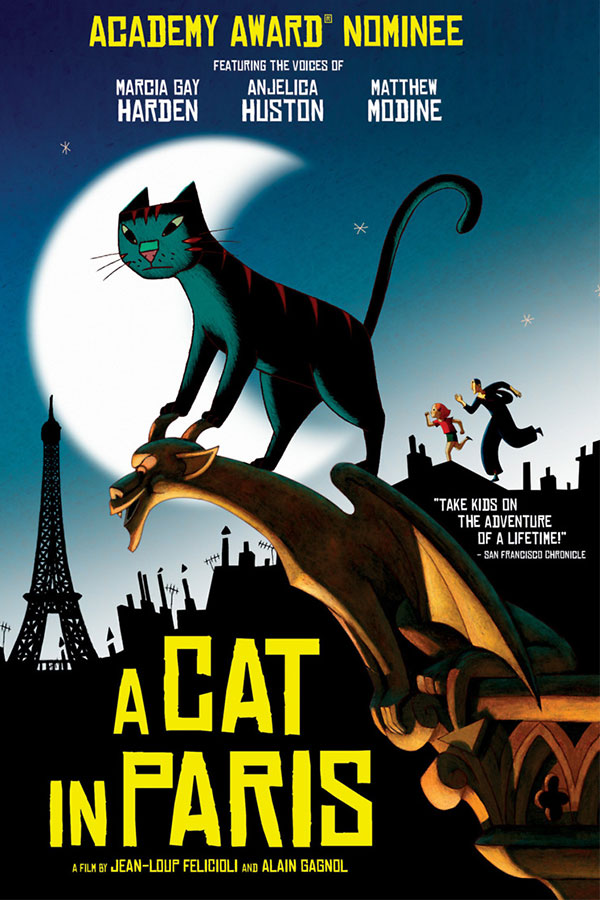
Another miracle of French animated movie bliss, a Cat in Paris once again deals with family. What makes a family and how to deal with the loss of a parent? Apparently you deal with it by following your pet cat who is helping a (literal) cat-burglar. To each their own way of grieving, but this one is at least beautiful and fun to watch.

Click on picture for IMDb page
Continuing the love for French movies is Eleanor's Secret (the last movie I watched). Another story dealing with loss, only this time it's a great-aunt that has passed and left a library to a boy who has trouble reading. The fairytale characters he only knows from being read the stories by his great-aunt come alive. They tell him he is the one who needs to save them. (This movie is especially wonderful for me, due to sequences that remind me of my all time favourite movie MirrorMask and my dyslexia and thus my inability to read out loud like the main character.)

And now ending on a movie that is most definitely not made for kids: The Congress.
Click on picture for IMDb page

Written by Ari Folman (who also made Waltz with Bashir), The Congress is a difficult movie to place, being half live-action and half animated. It's a haunting story of giving up your dreams for others and a world in which everyone is addicted to not actually existing but to merely being entertained. It is heartbreak in two hours, with Disneyesque animated sequences.

By just looking at all the posters of these movies it becomes clear that European animation is nothing like the American equivalent. The warm, fuzzy fairytales make place for original stories. The use of 3D animation is more rare, as hand drawn still makes up the greater part of the European animated feature (or at least the ones I watch). These are stories about family, about girls and women who are trying to find their place. These movies deal with the realities of life, mostly from a female perspective, without it being turned into a princess movie. There are no princesses here.

Thursday, September 17, 2015

On graphic design and my love/hate relationship with it

Once upon a time, there was a girl who studied industrial design. She had looked at al the creative things she could study and decided to do something with technology that was also art. She failed to finish her degree.

However, before she decided to go to university to study the art of design, she looked at graphic design with wariness and interest. She knew herself well enough to know it was not in her blood to make something for flat paper. So after a day she shoved the idea aside and went on with life. 

And now here I am. Making posters and flyers, some for a society, some for fun.


This is what I do with too much time on my hands. I started making stuff for flat paper. This particular design is a pick me up to get me off my ass and to be a good person. I'm currently waiting for it to be printed so I can hang it on my wall.

Or this amazing work of Photoshop beauty:


which will be plastered all over the back of a Fresher's Fayre stall. I may now know some more ways to use photoshop, but my sense of composition is not there yet, it seems.

I love beautiful designs and the wonder that can shine of a well designed page, but I'm self aware enough to know I should not be the person doing it, unless I'm the only one seeing the results...


Sunday, September 13, 2015

On the expected and what actually happens

The stress that is to come is already on my mind. There are still two days to go until it really will start. The meetings and the deliveries, the moving in and the new arrangements. I expect the uncomfortable next few weeks. Who knows now what will actually happen.

But I've learned over time, that my expectations rarely work out as planned.
I expected to study in the Netherlands, yet here I am, in the UK.
I expected to study something creative, like Design or Fashion, yet here I am, watching movies to write about them.
I expected hard work, yet here I am, with more time on my hands than I know what to do with and thus writing a blog post on a blog I've just started. 

I did not expect to have such strong reactions to one of my videos, that I'm still getting comments on it even though it's three years old.
I didn't expect to be making videos to start with. And here I am with a credit on IMDb because I helped a friend make a movie. 

I should have learned by now not to expect anything, but to just let life lead me on. Yet here I am, worried about next week, expecting...